
The American Dental Association (ADA), in collaboration with the American Academy of Oral and Maxillofacial Radiology, released updated clinical recommendations in 2026 outlining when CBCT is indicated, when it may be helpful, and when it is not supported by current evidence. These recommendations emphasize patient-centered decision-making, radiation safety, and the importance of matching the imaging modality to the specific clinical question.
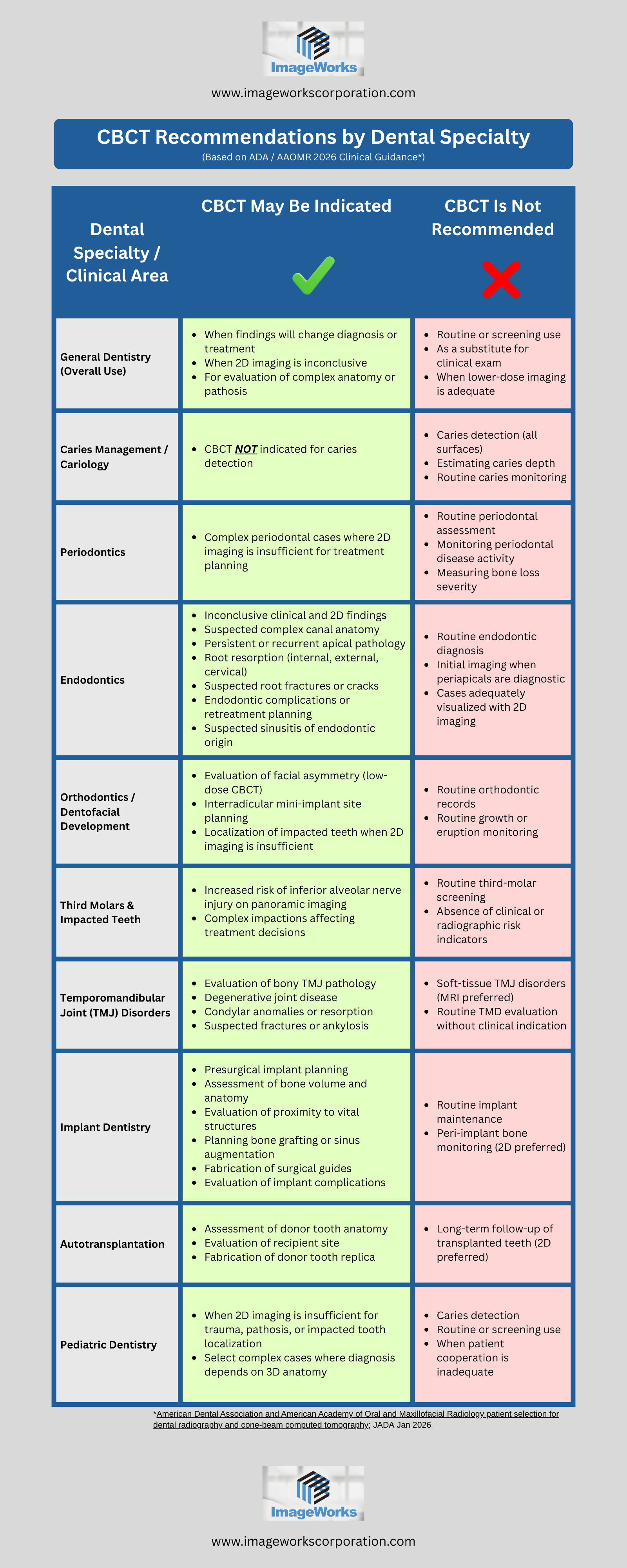
The infographic below is a visual summary of the ADA’s 2026 CBCT-specific recommendations, organized by dental specialty and common clinical scenarios. Rather than focusing on technology features, it highlights clinical decision points. It identifies situations where CBCT may meaningfully impact diagnosis, risk assessment, or treatment planning, as well as scenarios where CBCT use is not recommended. By presenting this information in a side-by-side format, the graphic is designed to be easy to scan, quick to reference, and practical for everyday clinical discussions.
Key Takeaways from the ADA CBCT Guidance
CBCT is not a replacement for a thorough clinical examination or conventional radiography
Routine or screening use of CBCT is not supported
CBCT is most valuable in complex cases where 2D imaging is inconclusive
Indications vary significantly by specialty and clinical scenario
Imaging decisions should be based on whether the scan will change diagnosis, risk assessment, or treatment planning
About ImageWorks
ImageWorks delivers dental imaging systems that combine excellent image quality, fair pricing, and dependable performance. Our goal is to help dentists and technicians succeed with digital imaging and 3D workflows.